
Sources Behind Past Walnut Residents
Previous residents appear through records with different dates and keys. The recorder's index carries deeds from 1851-present but requires a name and year. The assessor supplies current or effective parcel information. Aerials show site change, not occupancy. Census schedules provide household context through 1950. Directories and Sanborn maps may help, but Walnut-specific runs were not verified. The coverage table keeps each source honest.
| Source | Local years | Where held | What it shows |
|---|---|---|---|
| Recorder | 1851-present; one page says since 1850 | RR/CC Norwalk | Deed names, dates, legal descriptions; no address/web index |
| Assessor | Current or effective data | Portal plus specific inquiry | AIN, structure, value, events; owner not open online |
| Parcel aerials | 2008, 2011, 2014, 2017, 2020, 2023, 2024; 2025 fire imagery | County parcel context | Site and change context, not occupancy proof |
| GIS-NET aerials | 2001-02, 2006, 2008, 2011 and newer options | County GIS-NET | Landscape context; older-layer warning |
| City permits | Not published | Walnut Building & Safety or CPRA | Project and inspection chronology |
| Directories and census | Walnut run not located; census through 1950 | Libraries, archives, NARA partners | Occupant or household clues when geography fits |
| Sanborn maps | Walnut sheets not located | Library of Congress collection | Footprints and use if a local sheet is found |
Start with the source that can answer the time question. A deed can establish a recorded transfer, a permit can date work, a directory can show an annual address, and an obituary can close a life event. Previous residents become a defensible conclusion only when those roles are kept separate.
Start With Today's Walnut AIN
Enter the present address in the Los Angeles County Assessor Portal. Basic Search accepts the address or a 10-digit AIN; Legal Search accepts the assessment legal description. The portal can show situs, land and building size, units, beds and baths, year built or effective year, assessments, exemptions, recording events, document numbers, and parcel geometry. It does not provide an open owner-name search.
Ask the Assessor about one specific property by address or AIN through the county's phone, counter, or specific-property contact route. The property-tax FAQ lists (213) 974-2111 and (888) 807-2111. Preserve the inquiry date and distinguish the owner's mailing address from the situs. Neither proves everyone who occupied the house.
Image context: the Los Angeles County Homeowner Notification Program is the source for this related ownership-monitoring view. It is a notice service for a homeowner who creates a profile, not a public previous-residents database.
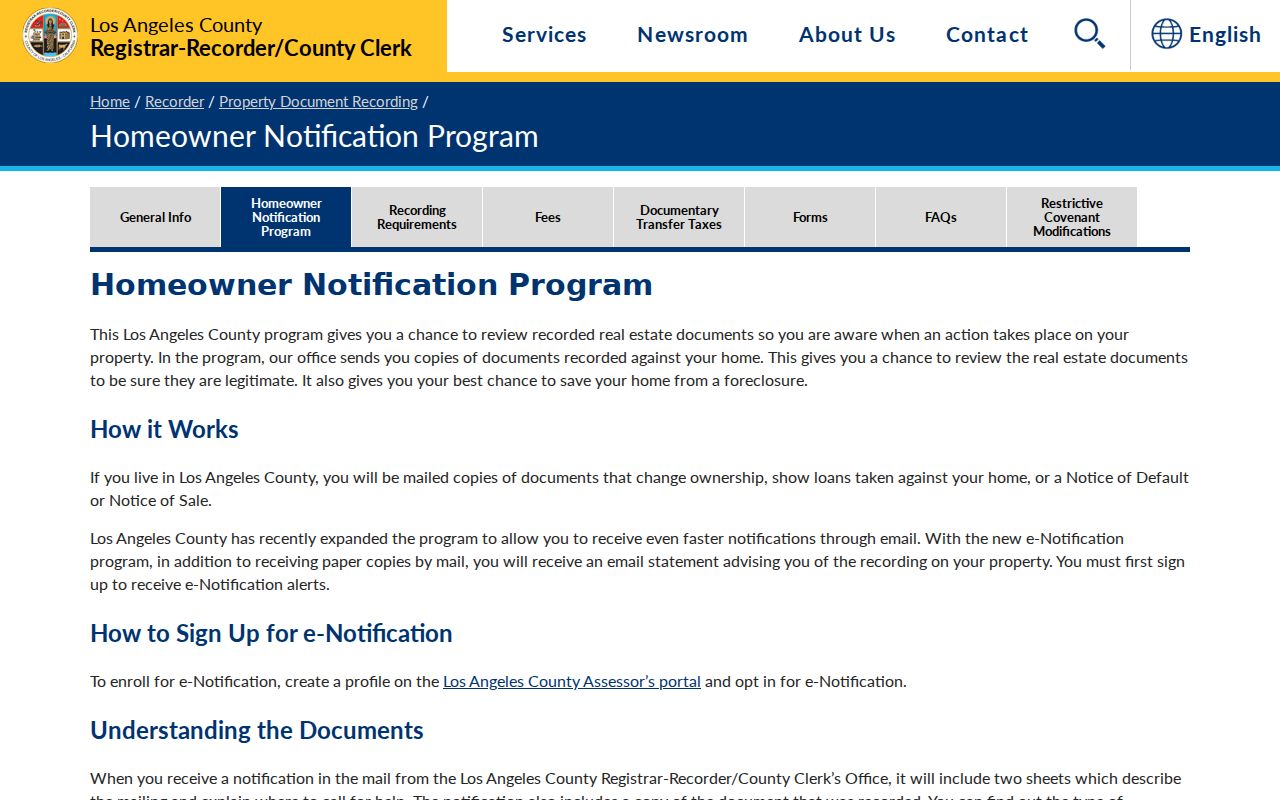
Notification programs can alert a participant after certain recordings. They do not replace an AIN handoff or establish the full household history.
Find a Walnut Acquisition Deed
At Norwalk, search the current owner as grantee in the approximate purchase year. Grantee means the party receiving the recorded interest. Read the complete acquisition document for recording date, document number, grantor, grantee, legal description, and any AIN reference. The RR/CC's official viewing page describes the index as alphabetical by name and year. It expressly says the recorder cannot search by address and offers no public internet real-estate index.
The recorder's FAQ is a useful access check because deeds, liens, notices, and maps belong there, while probate, wills, civil, criminal, family, and divorce records belong to Superior Court. Staff do not conduct telephone index searches. Appointments may be made up to two weeks ahead, and 1851-1957 records are on the lower level while 1958-present is on the second floor.
Image context: the RR/CC real-estate records FAQ is the source for this recorder-access capture. It explains why a previous residents search must carry a name and year to Norwalk.
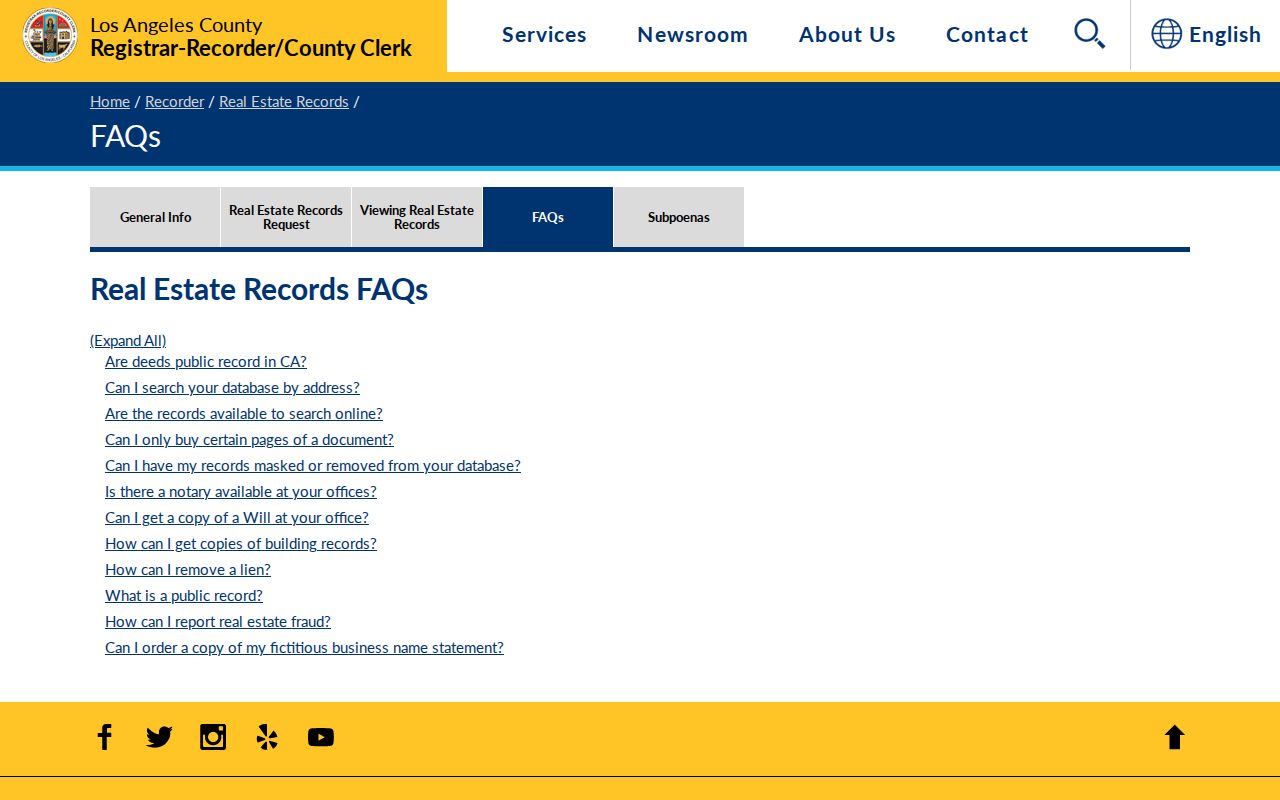
The absence of an address index is not a dead end. It tells you which handoff must happen first.
Walk Walnut Deed Chain Backward
Once the acquisition deed is identified, use its grantor as the next earlier grantee. Repeat the process until the chain reaches the time period that matters. A chain of title is the sequence of recorded interests in one legal parcel. It follows legal descriptions and names, not a modern street address.
- Record the present address, AIN, situs, and legal description from the Assessor.
- Obtain the specific owner through the Assessor's documented owner-inquiry route.
- Search that name as grantee at the recorder for the approximate acquisition year.
- Read the deed's grantor, grantee, date, document number, and legal description.
- Search each grantor as an earlier grantee and stop when the legal parcel no longer matches.
- Grantor
- The party transferring an interest in the recorded instrument.
- Grantee
- The party receiving the recorded interest.
- Chain of title
- A linked sequence of recorded interests in the same legal parcel.
- Legal description
- The land description in the instrument, which can bridge older records to a modern AIN.
A seller's later destination is not reliably disclosed. A mailing address in a purchased document may help research, but it should not be promised as a current home or a next residence.
Walnut Recorder Copy Requests
RR/CC copy orders are paid fulfillment, not online search. A plain copy is $5 for the first page and $3 for each additional page. A certified copy is $6 for the first page and $3 for each additional page. A staff search is $0.50 per name per year, with a $1 minimum and a nonrefundable search charge. Expedited mail or UPS is listed at $18.50, and credit-card handling at $1.75.
The online request route estimates fulfillment within twenty working days. Ask for the complete document and supply grantor, grantee, approximate recording date or year, document number when known, and the legal parcel clue. The copy can show the transfer, but it may not show a later destination or every person who occupied the property.
Image context: the RR/CC real-estate records request page is the source for this copy-order view. It is the mail and fulfillment channel after an index search identifies a document.
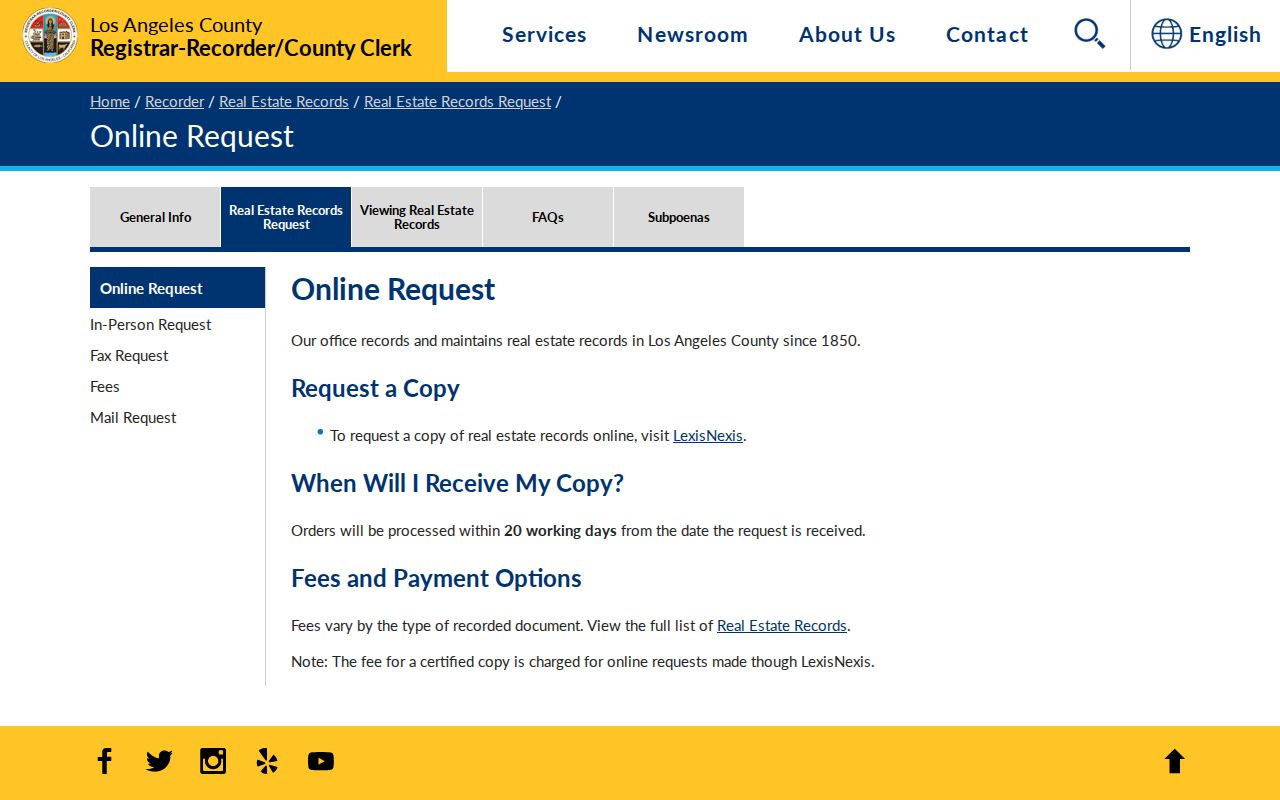
Use the recorder's own fee and request pages before responding to a private mail solicitation that mentions a real recording.
Walnut Recorder Floor Divide
The physical split is practical knowledge for previous residents research. Records from 1851-1957 are reviewed on the lower level at Norwalk; 1958-present is on the second floor. The wording on official pages differs on whether the earliest year is 1850 or 1851, so preserve that discrepancy rather than smoothing it away. Appointments may be made up to two weeks in advance.
Bring a name spelling list, approximate year, document number if known, and the legal description or AIN. Phone staff can explain the office or copy procedure, but staff will not perform a telephone index search. The counter, index, purchased document, and archive are four different access steps.
Image context: the RR/CC recorder fee schedule is the source for this cost reference capture. It helps separate a paid copy from a paid search and from a free portal.
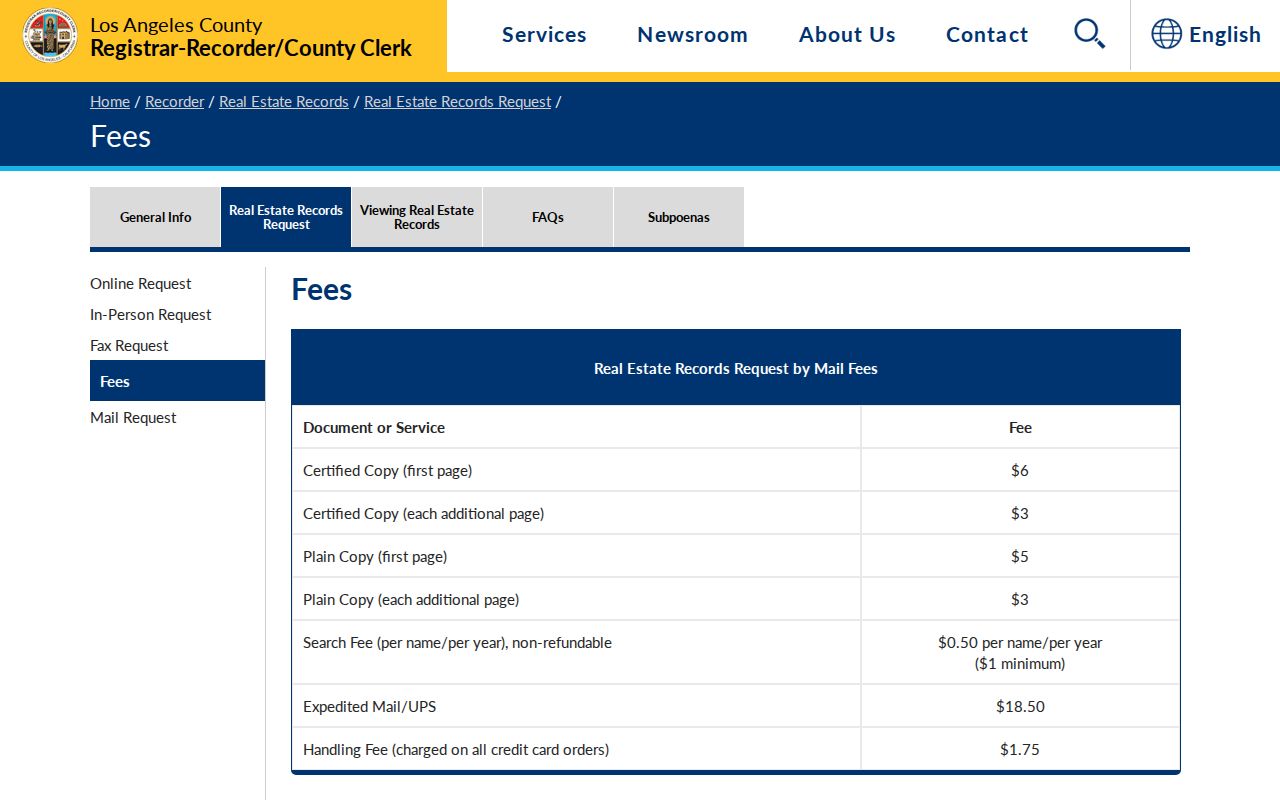
A previous residents budget should include the search method, copy type, delivery choice, and time needed to inspect the correct year range.
Walnut Permits and Past Residents
Building and Safety records can date construction, plan review, inspections, applicant or contractor activity, and final status. General information is available at (909) 595-7543, and inspection voicemail at (909) 598-5241 asks for the address of project, contact information, and type of inspection. Walnut provides guidance for additions, roofs, kitchens, HVAC, solar, accessibility, and other work.
No historical public permit database or coverage start date was verified. Request a date-bounded file from the City Clerk by exact address or AIN, permit type, and date span. A permit shows a project and named participants. It can support a house-history timeline, but it cannot prove who lived at the property before or after the work.
Walnut Directories and Past Addresses
LAPL holds U.S. directory film from 1861-1960, Los Angeles directories from 1873-1942, digitized Los Angeles-area runs from 1875-1987, and reverse volumes for 1906, 1927, and 1956-1987. Much of the reverse material focuses on Los Angeles city-limit communities. The research did not prove a Walnut-specific title, publisher, year run, or reverse run.
Search the catalog with City or Community=Walnut and County=Los Angeles. Test address OCR variants such as h or r prefixes, Ave 64 versus Avenue Sixty-Four, and Broadway versus Bway. Ask Walnut Library or Norwalk staff to confirm the actual page. The Walnut city directories page owns the collection description; previous residents uses only a verified volume as a time clue.
Walnut Census for Previous Residents
Federal census schedules are public through 1950 under the 72-year release rule. They can add age, birthplace, relationship, and household structure at an enumeration address. Walnut may be listed under an earlier township, ranch, or neighboring place, so match geography with a legal description or directory address. Most 1890 schedules were destroyed after the 1921 fire, creating a nationwide gap.
- Choose a directory year that sits near the census year and verify its community coverage.
- Copy the address and household names exactly, including spelling and relationship marks.
- Search the census by name and enumeration geography, not by a modern ZIP alone.
- Compare age, birthplace, household role, and address without forcing a match.
- Use newspapers, death indexes, probate, or obituaries to test a move or life event.
A directory is an annual address snapshot. A census is an enumeration snapshot. A previous residents narrative should say which one supports each conclusion.
Past Walnut Households and Endpoints
Obituaries and probate often close a former-resident trail. An obituary may report a death, family, service, or community connection. A probate filing may name a decedent, heir, or representative. State death and marriage indexes add event evidence. Newspapers at Walnut Library include Los Angeles Times through ProQuest, San Gabriel Valley Tribune, Sing Tao Daily, and World Journal. These sources report events and associations, not an automatic current address.
Close a trail with the fact that the source supports. A deed can show a transfer. A directory can show a printed address. A census can show a household at enumeration. An obituary can show a death and family relationship. Do not assume a grantor moved to a new address, and do not treat a former mailing address as a present residence.
House-history boundary. Ownership records are open for lawful personal research within their access rules. Never use a past address, family clue, or deed chain to stalk, harass, intimidate, or harm anyone.
Walnut Rancho Address Gaps
Before streets and ZIP codes, Walnut-area records used Rancho San José, Rancho de los Nogales, and Rancho La Puente descriptions. John Rowland and William Workman divided Rancho La Puente in 1868, while the name Walnut derives from Nogales. A title chain can therefore pass through a legal land description, tract map, and AIN before it reaches a current street.
Walnut tract clues include Three Oaks Tract 50867, Rodeo Ridge Estates Tract 48286, Camino de Teodoro Tract 72827, and Tract 26586. Stable current official map-document URLs were not verified. Preserve the tract name and request the map from the appropriate custodian rather than inventing a link or assuming every historical reference has a modern address.
The most useful previous residents result is often a bounded one: a named party, a recorded year, a legal parcel, and a household clue that agrees with another source. The gaps remain visible, which is better than filling them with a guess.