
Walnut City Directory Shelves
The verified holdings are broader than a single Walnut city directory title. The Walnut Library supplies local research help, newspapers, and databases. Norwalk's closed Californiana stacks hold censuses, periodicals, city directories, and local histories. LAPL holds national and Los Angeles runs, including reverse volumes. The table separates what is known from what still needs a catalog check.
| Collection | Years or run | Where held | Walnut access note |
|---|---|---|---|
| Walnut Library institutional history | 1916-present | Walnut branch and local records | Branch history, not a resident directory |
| Californiana census materials | 1850-1910 | Norwalk closed stacks | Ask staff to test Walnut and pre-city geography |
| Californiana city directories | Dating from the nineteenth century | Norwalk closed stacks | Exact Walnut titles and years are not verified |
| LAPL U.S. directories | 1861-1960 film; earlier fiche | Central reference holdings | Query Walnut or Pomona coverage before use |
| LAPL Los Angeles directories | 1873-1942; digitized 1875-1987 | Paper, film, and digital collections | Los Angeles runs are not automatically Walnut |
| LAPL reverse directories | 1906, 1927, 1956-1987 | Digital and reference holdings | Mostly Los Angeles city-limit communities |
| Telephone books | Los Angeles back to 1914; fiche 1976-2005 | LAPL reference materials | Ask for the Walnut exchange or address coverage |
Access is mixed. The Walnut branch offers telephone and in-person research help. Norwalk's collection uses closed stacks, so a staff request is part of the search. LAPL's central holdings may require a card or reading-room access, and the California State Archives provides catalog and reference pathways for state and historical government records. A scan or index hit is not enough until the community field is checked.
Walnut City Directory Repository Eras
Walnut Library began in March 1916 inside the original Walnut Elementary School. That founding predates Walnut's incorporation by forty-three years, which makes the branch's institutional record a useful bridge through the pre-city period. In 1964 the library shifted to a bookmobile model. A 3,250-square-foot storefront at 134 N. Pierre Street opened in 1970, and the current building opened on February 13, 1985.
The branch at 21155 La Puente Road now offers a Chinese Language Collection, catalog and database help, and access to Los Angeles Times material through ProQuest, the San Gabriel Valley Tribune, Sing Tao Daily's Los Angeles edition, and World Journal's Los Angeles edition. Hours are Tuesday and Wednesday noon to 8, Thursday through Saturday 10 to 6, and closed Monday and Sunday. Ask a reference worker to search names in both English and Chinese-language sources when a family trail calls for it.
Image context: the Walnut Library location page is the source for this local repository view. It anchors the Walnut city directory search in the branch that can help test local coverage.
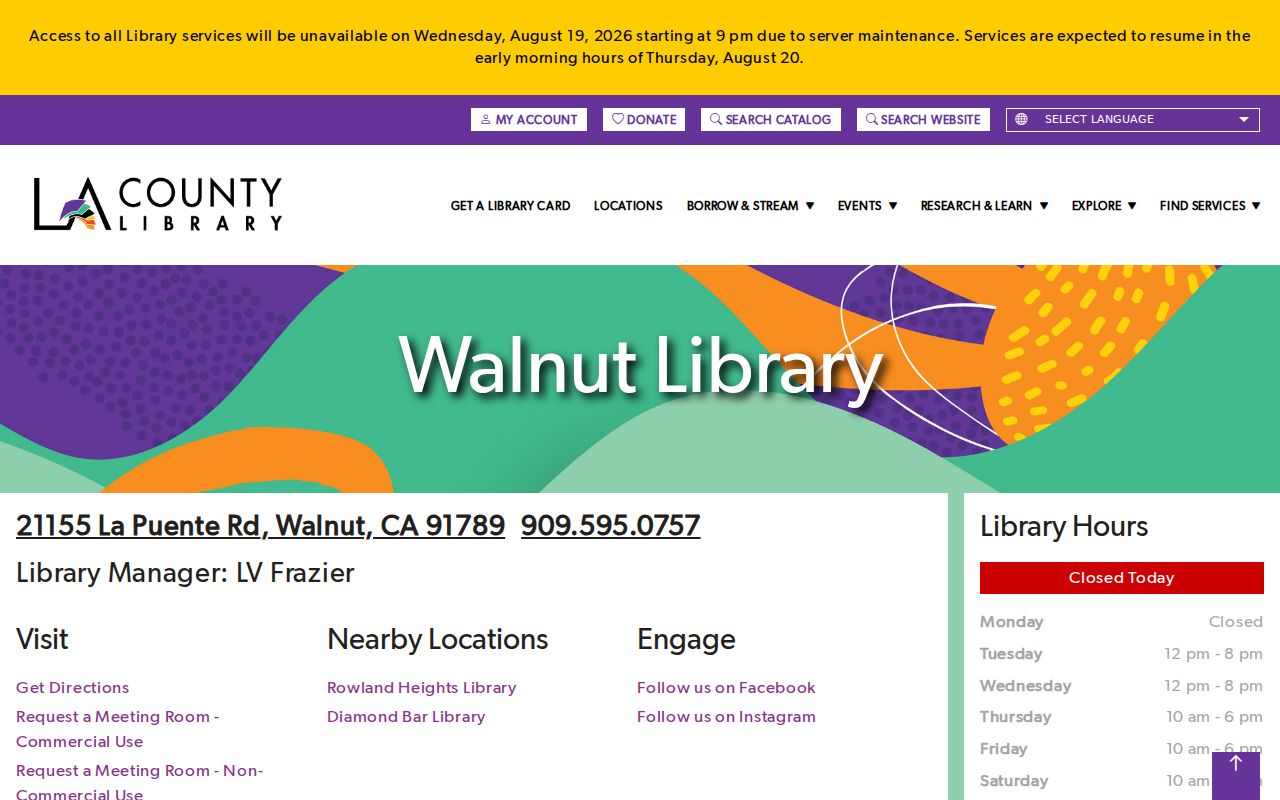
The branch history does not prove that a Walnut resident volume survived. It does show where a local catalog, newspaper, or staff-assisted lead can begin.
Walnut City Directory Stacks
The LA County Library Californiana Collection is held in closed stacks at Norwalk Library, 12350 Imperial Highway. It contains more than 24,000 books, over 200 newspaper and magazine titles in paper or microfilm, California censuses from 1850-1910, Alta California from 1849-1891, the Los Angeles Star from 1851-1879, nineteenth-century city directories, and official city and county histories.
Closed stacks change the search method. Prepare a name, address, probable community, and year range. Ask staff to test Walnut, eastern Los Angeles County, Pomona, and pre-incorporation geography rather than assuming a catalog label uses today's city name. A request may lead to a shelf item, microfilm reel, newspaper, or a negative result. Record which one it was.
The same caution applies to census records. The public federal census runs through 1950, but enumeration geography and the 72-year release rule matter. A household may be listed under a township, ranch, or neighboring place rather than Walnut. Pair the census location with a legal description, directory address, or newspaper before assigning it to a Walnut household.
Walnut City Directory Run Coverage
LAPL's History & Genealogy holdings include roughly 52,000 genealogy titles, family histories, town and county histories, and transcribed cemetery or probate records. The directory shelf includes more than 5,000 U.S. city-directory microfilm rolls from 1861-1960, earlier microfiche, about 1,000 paper directories, Los Angeles directories from 1873-1942, and digitized Los Angeles-area directories from 1875-1987.
Reverse or street directories are listed for 1906, 1927, and 1956-1987, but the research describes them as principally covering communities inside present Los Angeles city limits, with some county cities. No authoritative catalog source proved a Walnut-specific title, publisher, exact year run, reverse-directory run, or yearbook run. A Walnut city directory result must therefore carry its community qualification in the notes.
Digitized material can still help. Search the holdings index by keyword, City or Community, County, and two-letter State or Province. Use the result as a lead, then inspect the title page, publisher, place list, and abbreviation key. A Los Angeles image with a Walnut street name may be useful, but it is not automatically a Walnut edition.
How a Walnut Directory Entry Reads
A city directory entry is a compressed record, not a modern profile. A typical older entry may include the person's exact spelling, a title such as Miss, occupation or public role, an organization or public affiliation, home address, and a mark such as h for householder or r for resident. Some volumes put a spouse in parentheses or identify widow status. A government or board listing may sit beside personal entries.
| Entry clue | What to record |
|---|---|
| Name | Spelling, initials, title, suffix, and any alternate form. |
| Occupation | Occupation or public role, with affiliation only as printed. |
| Address | House number, street form, apartment or room detail. |
| h or r | Householder or residence notation, subject to that volume's key. |
| Spouse or widow mark | Relationship clue that needs confirmation in another source. |
- Criss-cross directory
- A reverse section arranged by address or street, revealing names attached to a formatted address.
- Householder index
- A name or address finding aid that may point to the head of a household rather than every person.
- Abbreviation key
- The volume's explanation of marks such as h and r. Photograph or transcribe it before reading entries.
Because publishers changed shorthand, never import the symbols from one Walnut city directory year into another without checking that volume's key. Treat occupation and address as clues that can distinguish two people with the same name, not as a complete identity proof.
Search Walnut City Directory OCR
Digitized city directories are often searched through OCR, or optical character recognition. A plain address may fail even when the page is present. ResCarta indexes can preserve an h prefix for a householder or r for a resident, so a search such as h443 N Av 52 may work where the bare address does not. Numbered streets may appear as Ave 64 or Avenue Sixty-Four. Broadway and Bway can require separate searches.
Start with the name, then test the exact address as printed. Search a surname with and without an initial, try a spouse or co-resident, and note the page image rather than trusting OCR alone. If a street changed form, test the older abbreviation. Preserve the volume year and page because OCR text can change when a collection is reprocessed.
Tracing Walnut Directories for Family History
Trace one household in small steps. Begin with a known name and address, then move through annual or near-annual volumes. Record the first appearance, each address change, the last appearance, spouse or co-resident clues, and the exact spelling. Search the same formatted address in a reverse section when the volume includes the relevant community. A disappearance can mean a move, death, omission, publication gap, or a changed street form.
- Find the strongest known name and address in the closest verified directory year.
- Copy the entry, abbreviation key, page, address, occupation, and relationship marks.
- Search forward and backward for the first and last appearance and all address changes.
- Search the same address for co-residents, then compare names with the next year's volume.
- Pair the directory trail with census, newspaper, vital, probate, or cemetery evidence.
Use the Walnut resident lookup page when a historical entry needs modern identity control. The city directory remains the historical collection owner; court, vital, property, and state records supply later verification.
Walnut Directories and Census Years
Directory years fill the gaps between federal census years. Through 1950, a census can add age, birthplace, relationship, and household structure, but the public release rule and enumeration geography limit what is available. The 1890 schedules were largely destroyed after the 1921 fire, so a gap there is a national records loss rather than a Walnut-specific omission.
Newspapers can add a reported move, marriage, death, school event, or civic role. Walnut Library access to the San Gabriel Valley Tribune, Los Angeles Times through ProQuest, Sing Tao Daily, and World Journal can help test English and Chinese-language name variants. Death and marriage indexes can close an event trail, while probate may identify a decedent, heirs, or representative. None should be treated as a current residence statement without a matching date and role.
Keep the sources side by side. A directory address is an annual snapshot, a census address is an enumeration snapshot, and an obituary is a reported event. The value comes from agreement across records, not from repeating one line.
Walnut Rancho Directory History
People research in the Walnut area can reach back before city streets. Rancho San José, Rancho de los Nogales, and Rancho La Puente supplied land descriptions that later became parcels and tracts. John Rowland and William Workman divided Rancho La Puente in 1868. The name Walnut derives from Nogales. A Rancho-era record may identify a grantee, family, or land boundary without using any modern street address.
California State Archives catalog and reference routes can help with state-government, land-grant, and historical material. Plats and legal descriptions then bridge the older land to later subdivisions. Preserve every original place name and spelling. A modern city directory is only one layer of a longer Walnut history.
Image context: the California State Archives is the source for this archives access view. It shows the reference path for records that predate a printed Walnut city directory.
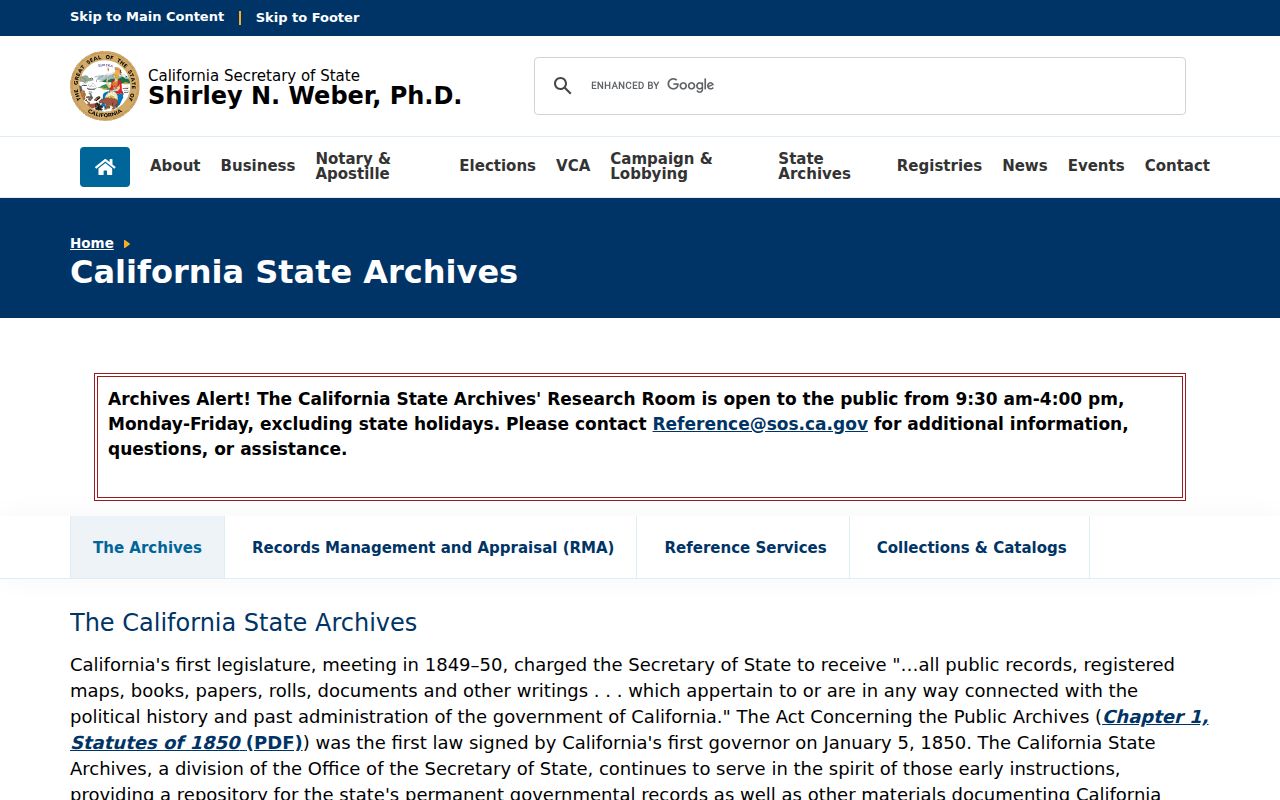
Archives reference copies are not certified RR/CC or court copies. Use the archive to discover a lead, then order the certified record from the proper custodian when one is required.
The Walnut City Directory Gap
The honest answer to several city directory questions is not yet verified. No authoritative source located a Walnut-specific directory title, publisher, exact annual run, reverse-directory run, yearbook series, or obituary index. No Walnut-specific Sanborn sheet year was located either. LAPL's Los Angeles material and the Norwalk Californiana shelves are valuable leads, but their coverage must be tested rather than relabeled.
Ask for a catalog search with City or Community=Walnut, County=Los Angeles, and State/Province=CA. Include alternate place names, Pomona-area geography, Rancho descriptions, and an address when known. Ask whether the result is printed, microfilm, digital OCR, a newspaper, a census, or a local-history item. Record the negative search too. It prevents a later researcher from treating an unverified volume as fact.
A reliable Walnut city directory trail ends with a clear citation: repository, collection, publisher if printed, year, page or image, community coverage, and the exact entry. That level of care keeps a historical clue useful without making it broader than the source.